
Sommaire :
Discover Fairglow's Methodology!
Bridging the Data Gap: A Scientific Approach to Sustainable Beauty
The beauty and health industries are integral to our daily lives, but their environmental footprint is significant, representing approximately 5% of the world's carbon footprint. While the industry generates 120 billion units of packaging every year, the sourcing of raw materials alone accounts for nearly a third of its total greenhouse gas emissions.
Despite the clear need for change, a major structural problem has long blocked progress: a massive lack of data.
The Transparency Challenge in Cosmetics
Conventional environmental assessments rely on Life Cycle Assessment (LCA) databases. However, there is a staggering gap in these resources: fewer than 1% of the roughly 30,000 cosmetic ingredients (INCI) in active use are covered by standard LCA databases.
Fairglow was founded in Paris in 2023 to bridge this gap. By combining expertise in theoretical chemistry, environmental science, and data engineering, the team developed a proprietary methodology to estimate the environmental impact of the 99% of ingredients that conventional methods miss.
A Rigorous, Certified Methodology
Methodological rigour is the backbone of reliable environmental claims. In 2026, Fairglow’s methodology achieved independent certification to ISO 14040, 14044, and 14067 standards by Bureau Veritas.
The methodology follows the three main principles of LCA:
- Life Cycle Thinking: Assessing a product from "cradle to grave"—from raw material extraction to final disposal.
- Multicriteria Reasoning: Looking beyond carbon to evaluate 16 different impact categories, including land use, water use, and ecotoxicity.
- Service-Rendered Reasoning: Evaluating the product based on its specific function, or "functional unit," such as a single dosage of shampoo or mascara.
How It Works: Overcoming the Data Deficit
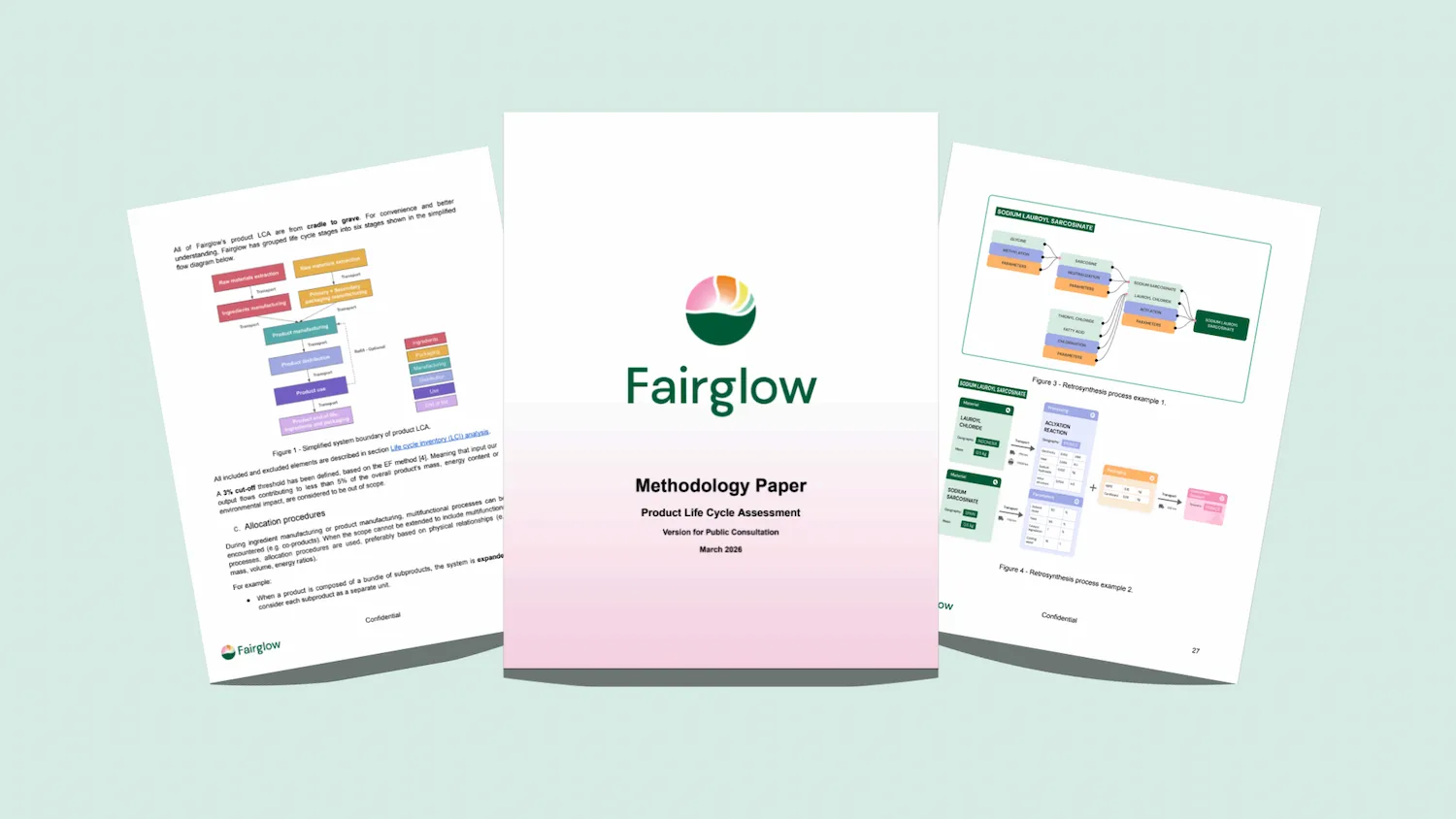
When documented inventory data is missing, Fairglow uses algorithmic modeling and retrosynthesis. This involves reconstructing the production steps of an ingredient—starting from the final product and working backward through chemical reactions and extraction processes—to estimate its environmental impact.
The Six Steps of a Product's Life Cycle
Fairglow’s assessment tracks a product through six steps:
1. Ingredients: Raw material extraction and manufacturing.
2. Packaging: Production of primary and secondary materials.
3. Manufacturing: Energy and water used during mixing, filling, and finishing.
4. Distribution: Downstream transport to distribution centers and retailers.
5. Use: Indirect impacts like the water and energy used by consumers during a shower.
6. End of Life: Disposal of packaging and wastewater treatment for the formulation.
Empowering the Future of Eco-Design
The ultimate goal of this data is to turn LCA into a practical decision-making tool for every brand. By providing precise data at scale, eco-design can move "upstream" - away from a single product result and into a portfolio analysis easily understandable by formulation labs and procurement desks.
When brands understand the "hotspots" of their products, they can make informed choices, for instance about ingredients and packaging that lead to real, measurable change. Environmental claims move from being mere aspirations to evidence-grounded facts.
To learn more about Fairglow's Product LCA Methodology, read the Methodology Paper v1.7, March 2026.


Articles similaires

Natural ingredients in cosmetics: Between environmental promise and dependency risk
Only through measurement can we assess the trade-offs, supply risks, and actual performance of the ingredients.
Science
8 Jul
Natural ingredients in cosmetics: Between environmental promise and dependency risk
Only through measurement can we assess the trade-offs, supply risks, and actual performance of the ingredients.
8 Jul

Cosmetic Formulations: Beyond Clean Beauty, the Environmental Challenge
Environmental impact is becoming a key consideration in cosmetic formulations.
Science
23 Jun
5
Min
Cosmetic Formulations: Beyond Clean Beauty, the Environmental Challenge
Environmental impact is becoming a key consideration in cosmetic formulations.
23 Jun

The challenges of LCA in the cosmetics industry and what is changing today
For years, LCA in the cosmetics industry has faced a twofold challenge: the complexity of the products and the difficulty in accessing data. That is changing today.
Science
7 May
The challenges of LCA in the cosmetics industry and what is changing today
For years, LCA in the cosmetics industry has faced a twofold challenge: the complexity of the products and the difficulty in accessing data. That is changing today.
7 May