
Sommaire :
Same INCI, carbon footprint multiplied by 22
.webp)
The bisabolol proof.
22 times. This is the ratio between several carbon footprints of the same cosmetic active ingredient, with different origins and production processes, calculated according to the same standards. Same INCI name, same soothing function. And sometimes, the calculations reveal surprises that intuition wouldn't have predicted. The LCA of 3 types of bisabolol illustrates this.
Same INCI name, vastly different origins and processes
Bisabolol is one of the soothing active ingredients particularly used in cosmetics: anti-aging serums, after-sun products, baby creams, aftershave balms. Under this single INCI name, several distinct origins coexist, with very different environmental profiles.
Fairglow conducted a comparative life cycle analysis on three of these: bisabolol extracted from Candeia (Eremanthus erythropappus), bisabolol derived from German chamomile (Matricaria chamomilla), and synthetic bisabolol, which nevertheless exhibits lower functional activity than the plant-based versions. A fourth origin – bisabolol produced by biotechnology, through the fermentation of sugars by genetically modified microorganisms – represents an emerging path but certainly one for the future.
What the data says
The table below presents the results for a functional unit (1) of 1 kg of finished bisabolol (Cradle to gate) (2), across eight environmental impact categories.
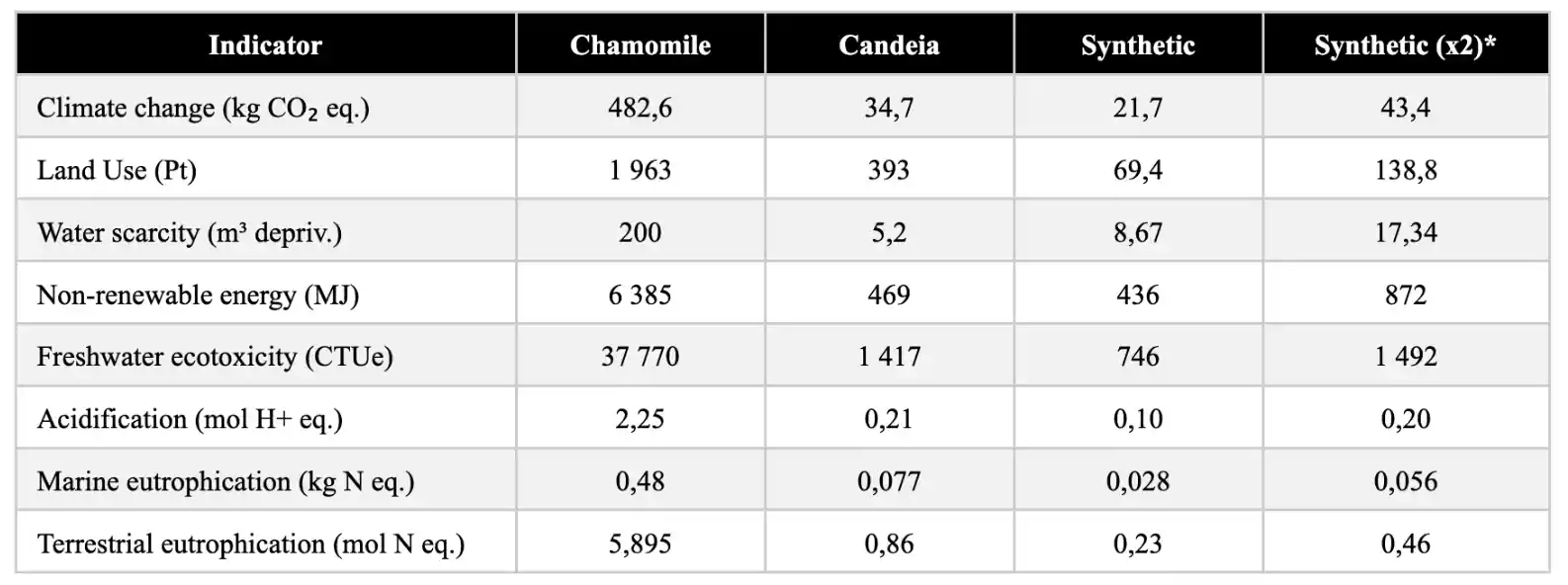
* Synthetic bisabolol exhibits lower functional activity than plant-based versions. For equivalent efficacy in a formula, the required dose is double. The x2 column reflects this formulation reality. Source: Fairglow Ingredient LCA Platform (2026). Methodology compliant with ISO 14040/44 and 1467, EF 3.0 characterization factors, ecoinvent 3.10 and Agribalyse 3.1.1 databases.
Chamomile shows the heaviest impact across almost all categories. Its Achilles' heel is structural: the flower contains the active isomer only in low concentration, which requires mobilizing a considerable amount of plant material to produce one kilogram of raw material. Its impact on climate change reaches 482.6 kg CO₂ eq, compared to 34.7 for Candeia.
Candeia presents a significantly more favorable profile, but its sourcing raises a major issue: historical harvesting in the Brazilian Atlantic Forest has contributed to the degradation of one of the planet's most threatened ecosystems. Controlled cultivation programs are developing under stricter operating regulations.
Synthetic bisabolol achieves the best results at equal mass. When adjusted for iso-functional activity, its profile degrades but does not become unfavorable. This is a surprise that intuition would not have predicted. Regarding climate change, it remains in a comparable order of magnitude to Candeia bisabolol (43.4 versus 34.7 kg CO₂ eq). For land use, it maintains a clear advantage.
Our takeaway: naturalness and environmental impact are two distinct things
Bisabolol illustrates a reality that only data can determine: three ingredients sharing the same INCI name can have incomparable environmental profiles. And the result does not always follow the expected hierarchy.
This analysis focuses on three origins. It does not claim to be exhaustive.
What this means for brands
For a brand making sourcing decisions, the challenge lies in comparing origins and processes, and measuring them: how, and at what functional dose? A substitution motivated by environmental convictions, without ingredient-level data, can degrade a formula's overall environmental footprint without anyone realizing it.
To meet the requirements of DPP, EMPCO, or simply to build a credible eco-design approach, ingredient-level environmental data is no longer optional. It is essential for informed decision-making.
Based on 11,000 completed LCAs, our platform can generate this data, from formula to packaging, within a standardized and certified framework.


Articles similaires

Environmental certifications are now a purchasing criterion
+24,7 % de ventes pour les cosmétiques certifiés grâce aux preuves environnementales visibles.
Insight
7 May
2
Min
Environmental certifications are now a purchasing criterion
+24,7 % de ventes pour les cosmétiques certifiés grâce aux preuves environnementales visibles.
7 May