
Sommaire :
The Secret Ingredient to Truly Sustainable Products
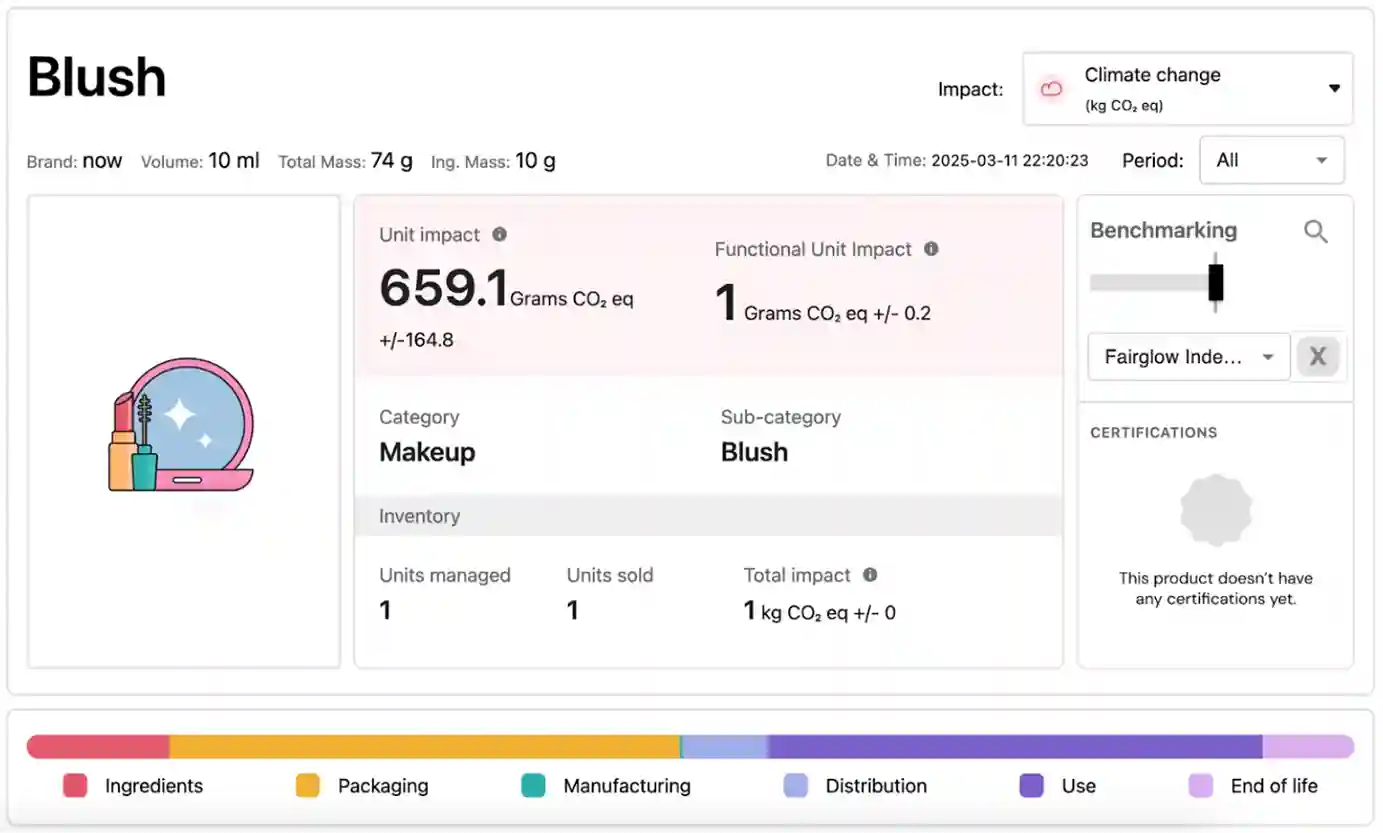
What you need to know about emission factors and why average isn’t good enough.
Emission Factors Are Used to Assess the Environment Impact of Activities and Products
At Fairglow, we measure the environmental impact of cosmetics and personal care products across 16 different impact categories including: climate change, toxicity, and water use. We do this by tracing the full life cycle assessment (LCA) for the product. This means we need to account for the impact of the following "activities": (1) raw ingredients, (2) packaging, (3) manufacturing, (4) transport, (5) use of the product, and (6) product end-of-life disposal.
Each "activity" in the LCA has a scaling factor between the amount of the activity and the impact that activity produces. That scaling factor is called the emission factor (EF). For instance, when making the above blush we might need to use 1 gram of the raw ingredient glycerin. The EF for glycerin would then tell us the impact of that 1 gram of glycerin. A typical glycerin EF might be 4.0 kg CO2 / kg, which means 4 kg of CO2 are produced when making 1 kg of glycerin.
By adding up all activities scaled by their emission factors we eventually derive the impact of creating this blush.
How do you get to an Emission Factor
It is possible to look up the emission factor for common ingredients like glycerin from publicly available databases. Similarly you can look up emission factors for:
- packaging materials,
- electricity and heat used in manufacturing processes,
- and for different transport modes.
However, most cosmetic ingredients do not have published emission factors. (Less than 10% of cosmetics ingredients have published EFs.) So determining the impact of a complex cosmetic product is extremely challenging, especially if you want to reduce your emissions.
What is traditionally done when an EF is missing is to apply a global average EF for the activity. For these ingredients there is no way of understanding which ingredient is contributing the most to your emissions.
Counterintutively, even for a simple ingredient like glycerin with published EFs, the EF that you look up may have very little relation to the EF of the actual glycerin used in preparing your product.
Let me explain.
Glycerin is made from fatty acid. But fatty acid can come from many different sources. It can come from palm oil, rape seed oil, or even synthetic sources. Each of those raw materials will result in a different EF, and thus a different total impact.
Even if we know that the raw material used is from palm oil we can expect that the emission factor could have a wide range of possible values. To get the "true" EF, we need to know, where was the palm grown?
- Was it produced in a high yield or low yield agricultural environment?
- Yields can vary by a factor of 5 or more by geography, as in the map for palm oil yields shown below.
Additional questions that could change the emission factor include:
- How much fertilizer was used, if any?
- How much irrigation was applied?
- How was the oil extracted from the raw palm seed?
- What modes of transport were used when shipping the oil to the factory?
- What electricity and heating blend was used in processing?
Given all of these variables, the EF for a given cosmetic ingredient can vary massively. Here are a set of model EFs for a single ingredient with different permutations of inputs.
This graph shows the climate impact across several hundred outcomes. At the low impact end (~13.5 kg CO2 / kg) there are a large number of realizations. But there is a long tail to much higher impacts. The biggest variation in this set of EFs occurs from considering air vs sea transport. Any air transport during the processing can result in massively larger climate impacts.
Clearly if you want to know the true impact of your cosmetic ingredient you need to be able to determine which of the many realizations above apply to your ingredient. Likewise if you want to reduce your impact you need to know what is driving your impact. Is it the agricultural yield? Is it the transport used?
So how does Fairglow help you do just that?
Solutions
Prior to Fairglow, EF calculation was undertaken by large consulting firms doing small numbers of ingredients over long periods of time at great expense. Thus, it has never previously been possible to generate thousands of bespoke emission factors at scale.
Fairglow has solved this problem.
We have developed tooling to run full LCAs of the raw chemical ingredients used in cosmetics, allowing for users to supply their exact inputs across a small number of key questions. These calculators return bespoke emission factors. If you know that your glycerin is from palm, grown without fertilizer in Indonesia and transported by boat and truck to your factory in France, we will calculate the EF for that exact glycerin. We can even tell you how your process is better than other realizations and how you can improve.
If you are the manufacturer or retailer of cosmetics, Fairglow will work with you and your ingredient suppliers to calculate the bespoke (true) emission factors of your ingredients. We will then use the bespoke EFs to calculate the impact of your products. Finally we will supply you with recommendations on ways to reduce.
If you are an ingredient supplier, Fairglow will help you quickly determine the EFs for your entire ingredient portfolio. You can then share the EFs with your manufacturers (a huge value add) or use them to identify ways to reduce your own emissions.
By working with Fairglow to make these measurements and recommendations, you can potentially reduce the emissions of your cosmetics products by factors of two or more without even changing your formulations.
Want to know the real emission factor of your ingredients?
Fairglow calculates custom ingredient-level emission factors so you can reduce Scope 3 emissions, back your ESG claims with real data, and drive smarter sourcing decisions.


Articles similaires
.webp)
Discover Fairglow's Methodology!
Description of Fairglow's environmental measurement methodology
Science
3 Aug
3
Min
Discover Fairglow's Methodology!
Description of Fairglow's environmental measurement methodology
3 Aug
Natural ingredients in cosmetics: Between environmental promise and dependency risk
Only through measurement can we assess the trade-offs, supply risks, and actual performance of the ingredients.
Science
8 Jul
Natural ingredients in cosmetics: Between environmental promise and dependency risk
Only through measurement can we assess the trade-offs, supply risks, and actual performance of the ingredients.
8 Jul

Cosmetic Formulations: Beyond Clean Beauty, the Environmental Challenge
Environmental impact is becoming a key consideration in cosmetic formulations.
Science
23 Jun
5
Min
Cosmetic Formulations: Beyond Clean Beauty, the Environmental Challenge
Environmental impact is becoming a key consideration in cosmetic formulations.
23 Jun