
Sommaire :
Is environmental labeling mandatory for cosmetics?
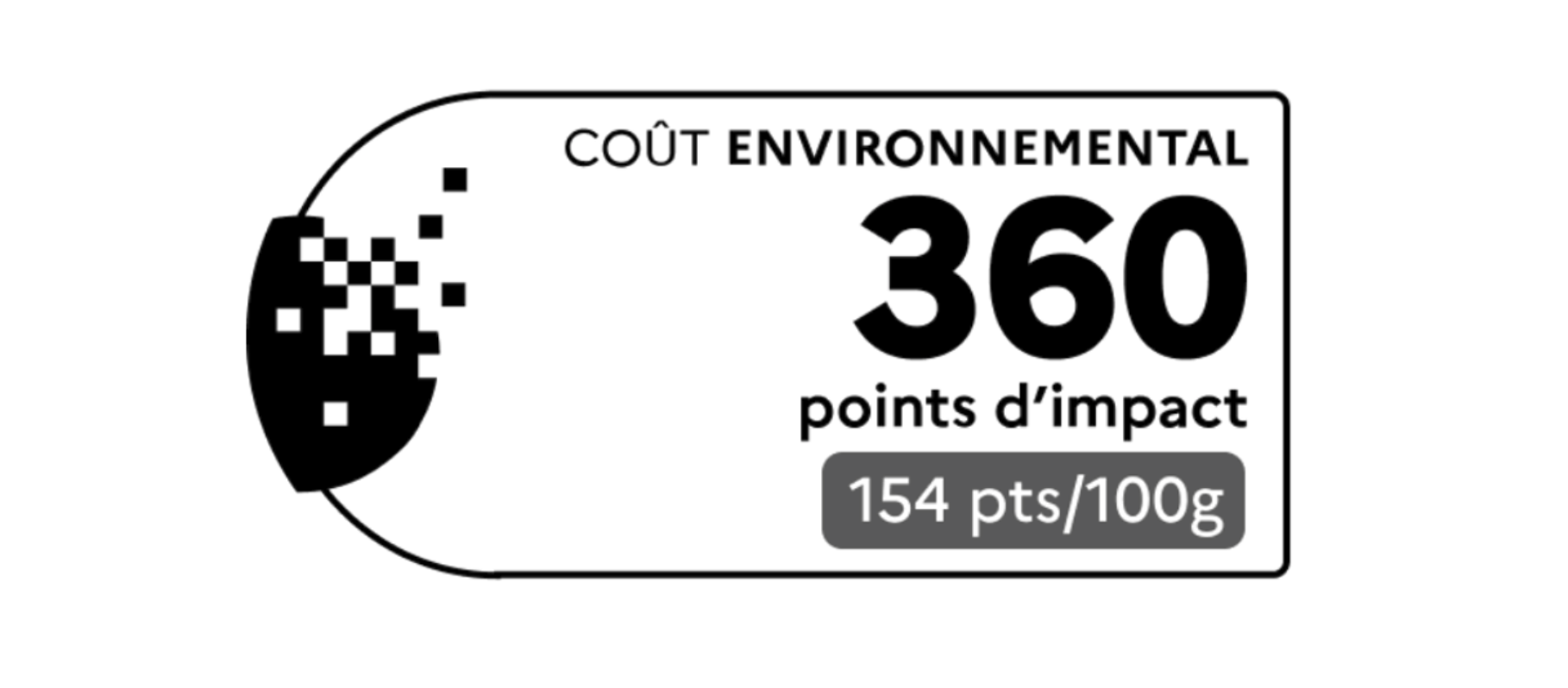
Not yet. But the shift is already well underway.
Since October 1, 2025, clothing brands in France have been able to calculate and publish the environmental cost of their products on an official portal run by ADEME, the national environment agency. By mid-2026, nearly 100 brands had signed on, covering 40,000 products.
Cosmetics aren't part of that first wave. But the gap is one of timing, not of principle. France's Climate and Resilience Act names cosmetics as one of the sectors slated for environmental labeling, and the EU's ESPR regulation will eventually bring the category within scope of the Digital Product Passport. The major beauty companies know this. They aren't waiting for the rules to land, and they're already building scoring systems of their own, together.
For cosmetics, environmental labeling is no longer a distant regulatory question. It's a shift already in motion, driven as much by the standards taking shape as by what the industry is doing on its own.
France's textile labeling rules take full effect on October 1, 2026
On October 1, 2026, France's environmental cost labeling scheme for textiles moves up a gear. Participation stays voluntary. But two provisions change the calculus.
The first ties environmental claims together. If a brand promotes a score covering one or more product impacts, a carbon footprint or a recycled-content figure, for example, it now has to publish the official environmental cost alongside it, on the same medium. The point is straightforward: one favorable number shouldn't hide the rest of a product's impact profile.
The second provision matters far more. It opens the calculation to third parties. If a brand doesn't publish an environmental cost for its products, a retailer, an advocacy group, or a comparison platform can calculate one from available or estimated data and publish it, no consent required. Until now, a third party needed the brand's agreement to do that. After October 1, it won't. A garment's environmental cost can be calculated and put in front of consumers whether or not the company that made it wants that to happen.
The rules also lock down the methodology. Decree No. 2025-957 and its implementing order, both dated September 6, 2025, set a single reference framework: a life cycle assessment across the 16 PEF indicators, plus factors specific to textiles. Brands run the calculation through Ecobalyse, the tool ADEME provides. The reason for that standardization is comparability. A score means nothing to a shopper unless one brand's number can be measured against another's, and only a shared method delivers that.
The Digital Product Passport builds environmental traceability across Europe
The French scheme is just the first layer. The bigger move is happening at the EU level, and it's more structural. The Ecodesign for Sustainable Products Regulation, or ESPR, took effect on July 18, 2024, and it phases in the Digital Product Passport: a standardized data set attached to every item, covering composition, environmental performance, durability, end of life, and more.
The difference in purpose is worth noting. France's environmental cost gives a shopper a score at the moment of purchase. The digital passport makes a product's environmental data accessible and verifiable across the entire value chain. The passport rolls out in stages, category by category, through delegated acts written for each product group. Textiles come first, along with industrial categories like steel, electronics, and furniture.
Cosmetics will follow. The regulation is built to cover, over time, every physical good sold in the European market, and beauty clearly falls inside that perimeter. The timetable still has to be set by delegated act. The direction doesn't. Environmental traceability is spreading sector by sector, and cosmetics sit squarely in its path.
The cosmetics industry isn't waiting for regulation to start measuring
Apparel is leading, but cosmetics won't be exempt. Back in 2021, the Climate and Resilience Act listed the category as one of four covered by environmental labeling, alongside textiles, food, and furniture. The method and the timeline are still open questions. And beyond labeling sits the Digital Product Passport, since ESPR is designed to reach consumer goods broadly.
The major beauty companies have concluded that product environmental impact is becoming a first-order issue. Nobody is forcing their hand. They've nonetheless pooled resources to build shared tools for scoring their products for consumers, starting now. Regulation isn't the driver here, because it doesn't yet apply to them. This is voluntary anticipation, and that's exactly what makes it worth paying attention to.
Two consortia have formed since 2021.
The first, EcoBeautyScore, was launched by L'Oréal, LVMH, Henkel, Natura&Co, and Unilever. It now counts more than 70 companies, including the world's largest beauty groups. Now incorporated as an association, EBS built a methodology on life cycle assessment and the PEF. From that base, it spent several years on scientific work to adapt the approach to cosmetics specifically. LCA specialists and industry experts designed the method, an independent panel reviewed it, and it went through two rounds of public consultation. The output is an A-to-E rating that lets shoppers compare products within the same category. Four categories are live today: shampoos, conditioners, shower gels, and facial skincare.
Nivea and Garnier were among the first brands to deploy it, in 2025. EBS plans to widen category coverage over time.
The second initiative, the Green Impact Index, takes a different route. Launched in France in 2021 by Pierre Fabre, it starts from a distinct premise: judge a product on its societal dimension as well as its environmental impact, in a deliberately holistic approach. Nine months of work brought together 120 participants from 26 organizations, from very small businesses up to the Pierre Fabre and Rocher groups.
That work produced AFNOR SPEC 2215 in 2023, a voluntary reference document built by stakeholder consensus. The specification has since been extended to fragrances, dietary supplements, and family health and wellness products. Here too, the rating runs from A to E.
The two initiatives differ, but they land on the same conclusion. Without any obligation, and without waiting for regulators to set the frame, the cosmetics industry is giving itself the means to measure and compare the environmental impact of its products. It's paying for that itself, collectively, and the results are already visible on shelf. An industry that builds this kind of infrastructure before anyone requires it isn't treating environmental measurement as a passing constraint. It's treating it as a permanent part of the business.
Measure now, and you can still improve the score before you have to publish it
An environmental rating does more than inform shoppers. It moves demand, and then it moves product design.
France's Nutri-Score, the front-of-pack nutrition label used across the food sector, shows how far that effect can travel. A NielsenIQ study presented in March 2026, built on grocery checkout data and a panel of 20,000 representative households, found that nearly two in three French consumers pay attention to the Nutri-Score when they shop for food.
That puts it level with Label Rouge, the long-standing French quality mark, cited by 64% of respondents. Label Rouge has been around for more than 60 years. The Nutri-Score has been around for fewer than 10. Its recognition climbed from 14% in 2019 to 63% in 2025, a 49-point gain in six years, against 14 points for Label Rouge and 13 for the organic AB label over the same stretch. In under a decade, it became one of the most recognized marks on the shelf.
Participating brands now account for 63% of sales volume in processed food across supermarkets and specialty retail. Participation runs high in plenty of categories: 93% for breakfast cereals, 93% for processed potato products, 92% for canned fruit, 88% for frozen ready meals, 85% for chilled deli, and 81% for dairy and chilled desserts.
The purchasing effect is documented. In the same NielsenIQ study, 41% of consumers said the Nutri-Score strongly influences what they buy, and 54% said that when they have a choice, they consistently take the better-rated product. Today, 71% of French consumers want it extended to all food products. Shoppers no longer take a brand's word for it. They want comparable information, produced the same way for everyone.
Cosmetics has already lived through a version of this, with no regulation involved at all. About a decade ago, ingredient-scanning apps planted themselves between brands and their customers, rating products against criteria no manufacturer had defined or approved, working only from what appeared on the packaging. Plenty of brands learned their products' ratings at the same moment the public did, with no chance to question the method. Faced with the consumer expectations those apps surfaced, a lot of companies rewrote their formulation policies.
The episode proved a simple point: when no shared assessment exists, whoever shows up first fills the space. What happened then to formula composition will happen next to environmental impact, with one difference. This time, the industry and the regulator are building the measurement framework.
For cosmetics, then, the real issue isn't the deadline. It's lead time. Once the data exists, an environmental score calculates fast. Improving it doesn't. Reformulating, swapping an ingredient, redesigning packaging, changing a process, all of it runs through development cycles, stability testing, regulatory validation, and industrial trade-offs. That takes years. A brand that discovers how its portfolio performs the same month labeling becomes mandatory has no runway left. It publishes what it has.
That gap between the speed of measurement and the pace of design is what makes moving early worthwhile. Measuring today isn't about getting ahead of a rule nobody has written yet. It's about knowing, product by product, where the impacts actually sit, which stages carry the most weight, and which ones can be improved at a cost that makes sense. That knowledge is the precondition for ecodesign, because you can only reduce what you've measured.
Doing it well means working across the full portfolio, not a handful of hero SKUs. For decades, companies designed products first and measured impact afterward. Going forward, measurement becomes part of the design work itself.
Brands with reliable environmental data will make sharper calls on formulas, packaging, sourcing, and claims. The ones without it will absorb requirements they never saw coming.
Environmental labeling, in the end, isn't the destination. It's a symptom of something larger: environmental impact is turning into a management metric, tracked alongside cost, quality, and product performance.
FAQ
Is environmental labeling mandatory for cosmetic products?
No. As of today, no environmental labeling requirement applies to cosmetic products. The sector is one of four product categories named in France's 2021 Climate and Resilience Act, alongside textiles, food, and furniture, but neither the calculation method nor the compliance timeline has been finalized.
What changes on October 1, 2026 for textile brands?
Two rules that had been transitional take full effect. A brand making an environmental claim about its products must also display the official environmental cost on the same medium. And if a brand doesn't publish that cost, a third party can calculate it from available or estimated data and publish it without the brand's consent.
What is EcoBeautyScore?
It's a shared system for assessing the environmental impact of cosmetic products, developed by a consortium formed in 2021 by major beauty groups and now numbering more than 70 companies. Built on life cycle assessment and the European Product Environmental Footprint method, it converts a product's impact into an A-to-E rating that allows comparison within a category.
What is the Green Impact Index?
It's an environmental and societal rating initiative launched in France in 2021 by Pierre Fabre and later expanded into a consortium. It produced AFNOR SPEC 2215, a reference specification for labeling environmental and societal impact, open to companies of any size.
Will cosmetic products be covered by the Digital Product Passport?
Yes, at a later stage. The EU's Ecodesign for Sustainable Products Regulation, effective July 2024, is designed to cover every good sold in the European market over time. Textiles and industrial product groups are first in line. No delegated act and no date currently applies to cosmetics.
Why measure the environmental impact of your products before you have to?
Because a score calculates quickly once the data exists, while improving it takes years of reformulation, testing, and validation. Measuring early lets you find the heaviest impact areas and act on them before the score goes public.
Sources
Decree No. 2025-957 of September 6, 2025, on methods for calculating and communicating the environmental cost of textile products, Légifrance
https://www.legifrance.gouv.fr/jorf/id/JORFTEXT000052212871
Order of September 6, 2025, on labeling and calculation methodology for the environmental cost of apparel textiles, Légifrance
https://www.legifrance.gouv.fr/jorf/id/JORFTEXT000052213047
French Ministry for Ecological Transition, launch of environmental cost labeling
https://www.ecologie.gouv.fr/presse/mode-durable-laffichage-du-cout-environnemental-vetements-est-lance-partir-du-1er-octobre
Methodological note for calculating the environmental cost, Ecobalyse
https://affichage-environnemental.ecobalyse.beta.gouv.fr/notice-reglementaire.pdf
Regulation (EU) 2024/1781 establishing a framework for setting ecodesign requirements for sustainable products, EUR-Lex
https://eur-lex.europa.eu/eli/reg/2024/1781/oj?locale=fr
Official summary of the regulation, EUR-Lex
https://eur-lex.europa.eu/legal-content/FR/TXT/?uri=LEGISSUM:4761760
EcoBeautyScore, published methodology
https://www.ecobeautyscore.com/app/uploads/2025/07/EBS-Simplified-Methodology_FOR-USE-BY-BRANDS.pdf
EcoBeautyScore, tool launch press release
https://www.ecobeautyscore.com/app/uploads/2025/03/ENG-EcoBeautyScore-press-release-Mar-2025-VF.pdf
Green Impact Index, official website
https://www.greenimpactindex.com/
Pierre Fabre, publication of AFNOR SPEC 2215
https://www.pierre-fabre.com/fr/article/green-impact-index-afnor-spec-2215-impact-environnemental
AFNOR SPEC 2215, reference document record
https://www.boutique.afnor.org/fr-fr/norme/afnor-spec-2215/affichage-de-limpact-environnemental-et-societal-des-produits-cosmetiques-d/fa205627/347951
Nutri-Score explained, A to E, INRAE
https://www.inrae.fr/actualites/nutri-score
How the Nutri-Score pushed manufacturers to reformulate, France Inter
https://www.radiofrance.fr/franceinter/podcasts/l-info-de-france-inter/l-info-de-france-inter-6408559
NielsenIQ study on Nutri-Score perception and purchasing influence
https://nutriscore.blog/2026/03/24/une-etude-de-nielseniq-fournit-des-informations-sur-la-facon-dont-nutri-score-est-percu-et-influence-les-achats-alimentaires-des-consommateurs/
Oqali 2025 review of Nutri-Score adoption, INRAE
https://www.inrae.fr/actualites/nutri-score-leger-desengagement-mobilisation-renforcer-marques-nationales


Articles similaires

PWR, EMPCO, UWTD: Why are these regulations a game-changer?
Behind these new regulations lies a more profound transformation for the cosmetics industry.
Reglementation
10 Jun
PWR, EMPCO, UWTD: Why are these regulations a game-changer?
Behind these new regulations lies a more profound transformation for the cosmetics industry.
10 Jun

The EU’s Corporate Sustainability Reporting Directive (CSRD) for Cosmetics
Reglementation
13 Jan
5
Min
The EU’s Corporate Sustainability Reporting Directive (CSRD) for Cosmetics
13 Jan
Implications of EU Deforestation Regulation for the Cosmetics Industry
Reglementation
10 Dec
5
Min
Implications of EU Deforestation Regulation for the Cosmetics Industry
10 Dec