
Sommaire :
The cost of climate inaction: What Fashion teaches Beauty’s finance leaders

Carbon, energy, raw materials: how environmental performance becomes a matter of margin and profitability.
A 34% drop in net profit by 2030. That is what an apparel brand faces if it fails to act to reduce its exposure to climate-related risks, according to The Cost of Inaction, the report published in February 2026 by the Apparel Impact Institute. The fashion industry has long known that the environment carries a cost. But how much, and what is its effect on the income statement if climate issues go unaddressed? The report sets out to answer that question. While it focuses on one specific sector, apparel, the question it raises reaches well beyond that industry.
How much does climate inaction cost a brand?
Unusually, this study addresses finance functions, executive committees and boards. Its finding is straightforward: climate-related risks are no longer theoretical or distant. They now show up in companies’ operating costs, margins and profitability.
Produced in partnership with Accenture and in collaboration with experts from several major fashion brands, the study quantifies this exposure. To do so, the authors modelled the financial impact of climate on a representative apparel brand with 16 billion dollars in revenue and an operating margin of 9 to 10%.
The result is stark. Without action, brand profit falls by 34% by 2030, and by as much as 67% by 2040, under the combined effect of three risks: the rising price of carbon, the rising cost of raw materials and the rising cost of energy.
The price of carbon, first. It is set to become a major cost factor. With the growth of carbon markets, the expansion of taxation mechanisms and the arrival of the European Carbon Border Adjustment Mechanism (CBAM), the costs tied to greenhouse gas emissions move gradually up the value chain to brands, all the more so as most emissions sit in Scope 3, at the suppliers’ level. In the worst-case scenario used by the report, based on NGFS projections, the price of carbon exceeds 500 dollars per tonne of CO₂ by 2040. For a brand that has not decarbonized its value chain, this item alone raises the cost of goods sold (COGS) by around 13% and weighs directly on margin.
The cost of raw materials, next. Cotton is the most exposed example. In 2022, torrential rains in India, heatwaves in China and droughts in the United States were enough to push its price up by 30% in a single year. By 2040, nearly half of producing regions will experience higher temperatures. Even a moderate fall in global output raises prices and erodes margins. This logic applies to all materials dependent on natural resources, not to cotton alone.
The cost of energy, last. Suppliers that remain dependent on fossil fuels face growing price volatility as well as additional regulatory costs. Conversely, investments in the electrification of industrial processes and in renewable energy appear as levers to stabilize costs over the medium term.
Not all companies are exposed in the same way. The authors distinguish three profiles: wait-and-see players (conventional operators), with little commitment to the transition; pragmatists, who go no further than regulatory compliance; and pioneers, who actively invest in decarbonizing their value chain. By 2040, the exposure gap between the wait-and-see player and the pioneer reaches a factor of four to five.
The conclusion is unambiguous. Climate inaction has become a cost that weighs on brands’ bottom line. Conversely, investments in decarbonization, energy efficiency, renewables and supply resilience should be read as a protection of margins rather than as an expense. Environmental performance thus becomes a matter of competitiveness and economic resilience.
Why cosmetics should look closely at this study
Does a report devoted to apparel really concern the cosmetics industry? Although their margin structures differ greatly, the two industries share several characteristics.
Like fashion, beauty concentrates most of its footprint in Scope 3, at its suppliers of raw materials and packaging, as well as in the use phase for rinse-off products. While many brands already manage the carbon of their own operations, they have yet to manage the heavier carbon of their products. Packaging and petrochemical-based ingredients are particularly affected, and two factors weigh on their cost.
The first factor is energy. Producing glass requires furnaces heated to very high temperatures; making a polymer draws on an entire petrochemical chain. When energy becomes more expensive at the supplier, it is the price of the packaging delivered to the brand that rises.
The second factor, more indirect, is the CBAM, the European Carbon Border Adjustment Mechanism, which the report cites as a sign of the direction of travel. It does not yet affect fashion and cosmetics suppliers, but it establishes the principle of a carbon cost on imports, one set to spread.
For packaging, this carbon cost adds to another already familiar to the industry: the eco-modulation set out by the PPWR, which adjusts the Extended Producer Responsibility fee according to the recyclability of the packaging. The pressure can concentrate where packaging serves as a signature: the sophistication of the container, its volume, weight, assemblies and finishes. These choices become cost variables from the design stage onward.
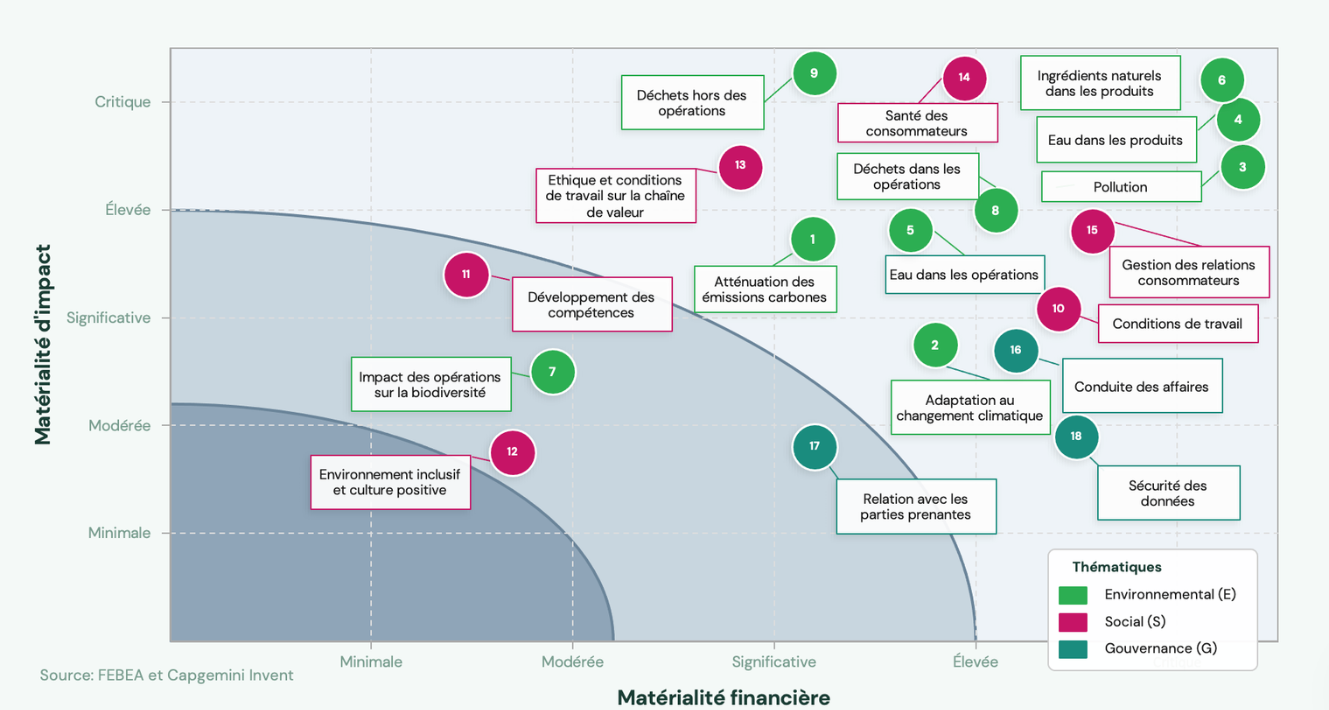
Like fashion, the beauty industry is highly exposed to the uncertainties of sourcing natural materials. The double materiality matrix produced by FEBEA established it plainly: natural resources are the industry’s foremost issue. Global warming will profoundly affect harvests, which also depend on the health of soils and biodiversity, at the end of long supply chains with highly uneven practices. The sector has already experienced shocks. Patchouli is a textbook case. In 2008, the essential oil ran short. Even though global warming was not the cause at the time, the industry still remembers it. Patchouli is a central ingredient in a great many fragrances, one that cannot be substituted.
In the face of environmental pressures, sourcing will become more complex, with a possible impact on the income statement. Measuring the fragility of a supply chain, and choosing between an exposed natural ingredient and an alternative with equivalent function and lower impact, will become essential components of economic performance. But the challenge does not stop at natural ingredients. Water, too, is a critical resource at every stage of the life cycle. Water stress could become a significant financial variable.
A rise in the price of a plant-based active or of packaging has long been seen as a market blip, to be renegotiated at the next purchasing cycle. Under the strains linked to global warming, it is now a structural increase, one that will not recede.
Eco-design, a lever for the cosmetics industry
Eco-design plays a major role here, on packaging as on formulation. On packaging, it reduces the material and carbon embedded: a leaner, mono-material container that is easier to recycle costs less to produce and lowers the eco-contribution owed under the PPWR.
On formulation, it acts on exposure to raw materials. Choosing a lower-impact ingredient often means choosing an ingredient less dependent on resources under strain, whose supply is more secure and whose price is more stable. The link is not automatic: an active can be low-emitting yet remain fragile if its supply chain is single-source or exposed. It is measurement that makes it possible to decide, and to secure one’s supply on an informed basis.
That leaves the use phase. For a rinse-off product, the largest source of impact is neither manufacturing nor ingredients, but the hot water used for rinsing. This impact is not a cost to the brand; it is borne by the consumer. But consumer-facing environmental labelling could change this, since the use phase is included in the score. A formula that rinses off faster, at a lower temperature, concentrated or solid, will perform better.
In every case, the trade-off requires having measured.
The Apparel Impact Institute’s study shows that climate inaction is not a distant risk. It is a cost already forming, at the suppliers’ level, and moving up to margin. Funded by HSBC and Zalando, and informed by contributions from experts at major houses, from Mango to Puma, Adidas, Lacoste, Ralph Lauren, PVH, H&M Group and Target, it also shows that the fashion industry and the world of finance have fully grasped what is at stake.
It opens the way for cosmetics, with which it shares many common denominators. This awareness matters all the more because climate is not the only sustainability-related financial risk to which beauty is exposed. Toxicity is another, potentially very costly: the Urban Wastewater Treatment Directive (UWWTD) already turns it into a charge, by requiring the industry to help fund the treatment of micropollutants discharged into water. The real question is no longer whether all these issues will have a financial impact, but how to anticipate and manage them.
Frequently asked questions
How much can climate inaction cost a brand? According to the Apparel Impact Institute’s report The Cost of Inaction, a representative apparel brand that fails to act could see its profit fall by 34% by 2030 and by as much as 67% by 2040, driven by the price of carbon, the cost of raw materials and the cost of energy.
How does a study on apparel concern cosmetics? Both industries concentrate most of their footprint in Scope 3, at their suppliers, and depend on natural materials and packaging exposed to the same price, carbon and energy risks. The mechanisms affecting fashion apply to beauty.
What is carbon risk for a cosmetics brand? It is the rising cost of greenhouse gas emissions, located mainly in Scope 3. With the expansion of carbon markets and the Carbon Border Adjustment Mechanism (CBAM), this cost moves up from suppliers to the brand’s margin.
Does eco-design really reduce costs? On packaging, a leaner, mono-material container reduces the material and carbon embedded and lowers the eco-contribution owed under the PPWR. On formulation, a lower-impact ingredient is often less exposed to sourcing strains. The gain is not automatic: only measurement can establish it.
What is the UWWTD and its financial impact on cosmetics? The Urban Wastewater Treatment Directive, revised in 2024, introduces Extended Producer Responsibility for the treatment of micropollutants. It makes cosmetics bear part of the cost of cleaning up water, turning a toxicity issue into a financial charge.
Sources
Apparel Impact Institute, The Cost of Inaction, February 2026, developed with Accenture, supported by HSBC. https://apparelimpact.org/resources/cost-of-inaction/
Network for Greening the Financial System (NGFS), reference climate scenarios used for carbon price projections. www.ngfs.net
Regulation (EU) 2023/956 establishing a Carbon Border Adjustment Mechanism (CBAM). https://eur-lex.europa.eu/eli/reg/2023/956/oj
Regulation (EU) 2025/40 on packaging and packaging waste (PPWR), applicable from 12 August 2026. https://eur-lex.europa.eu/eli/reg/2025/40/oj
Directive (EU) 2024/3019 concerning urban wastewater treatment (UWWTD recast), introducing Extended Producer Responsibility for micropollutants. https://eur-lex.europa.eu/eli/dir/2024/3019/oj
FEBEA and Capgemini Invent, Double materiality analysis of the French cosmetics industry, 2024. https://www.febea.fr/etudes-et-rapports/analyse-double-materialite-la-filiere-cosmetique-travail-inedit-collaboratif-la


Articles similaires
L'environnement devient un enjeu de compétitivité pour la filière cosmétique
Buisness performance
15 Jul
L'environnement devient un enjeu de compétitivité pour la filière cosmétique
15 Jul

Cosmetics brands’ new specifications
Pourquoi façonniers et maisons de parfum doivent mesurer l'impact environnemental des produits
Buisness performance
8 Jul
Cosmetics brands’ new specifications
Pourquoi façonniers et maisons de parfum doivent mesurer l'impact environnemental des produits
8 Jul