
Sommaire :
Cosmetics brands’ new specifications

Why CDMOs and Fragrance Houses will have to provide environmental proof
From the technical data sheet to measured impact data: what brands will demand of their suppliers tomorrow.
In 2021, several major global beauty groups, including L’Oréal, Henkel and LVMH, created the EcoBeautyScore consortium to build a common system for rating the environmental impact of cosmetics. The same year, Pierre Fabre rolled out its Green Impact Index. Building shared methods takes time, but the existence of these consortia shows that the environmental impact of cosmetic products has become an industry-wide issue.
Yet in cosmetics, the brand designs, positions and markets, but a significant share of products is developed and produced by contract manufacturers. Each time a link is delegated, most of what determines a product’s environmental impact takes place beyond the brand’s view: the development of the formula, the selection of most raw materials, their origins, and the manufacturing and processing methods. What brands will now have to prove, they cannot prove on their own.
This requirement will become part of the specifications, just as health pressure did before it. Many brands already require “Yuka-compatible” products. Environmental pressure follows the same path: it will first impose measurement, the ability to quantify the footprint of what is made, then performance, developing products that are genuinely less impactful. These two requirements will redefine what brands ask of their contract manufacturers and their perfumers.
Environmental labelling, LCA and Digital Product Passport: what textiles already require signals tomorrow’s cosmetics
The textile industry is the laboratory for what awaits cosmetics. In France, environmental cost labelling for clothing has been in place since 1 October 2025, on a voluntary basis. Decree no. 2025-957 and its implementing order, published on 6 September 2025, set the framework: a common method, based on the European Product Environmental Footprint (PEF) reference and Life Cycle Assessment (LCA), with its sixteen impact indicators. Nearly 100 brands and retailers have already joined the scheme, from ready-to-wear to mass retail, and more than 40,000 products are now listed on the official portal. The scheme remains voluntary, but from October 2026, a third party, a retailer, an NGO or a competitor, will be able to calculate and publish the environmental cost of a brand that abstains, on the basis of unfavourable assumptions.
A second regulatory strand, European this time, will extend the obligations. The ESPR, Regulation (EU) 2024/1781 on the ecodesign of sustainable products, has been in force since July 2024. Textiles and clothing will be among the first affected by the roll-out of the Digital Product Passport (DPP). Each product will have to carry structured, verifiable and updated environmental data, accessible through a marker affixed to the product, whose existence will condition market access. The passport will thus become the point where the information that other texts already require separately is consolidated, from packaging to the product’s footprint.
While textiles are currently treated as a priority, the fourth-largest environmental pressure of European households according to the European Environment Agency, make no mistake: what fashion is trialling today, the beauty industry will face tomorrow.
Why consumer expectations and regulation push environmental proof toward suppliers
Environmental proof, when it is structured and shown at the right moment, sells, as newly available studies show. Yet while consumer demand for sustainability has long been documented, on the environmental front the move to actual purchase remained uncertain.
A study by Davide Proserpio (University of Southern California) and co-authors, published in April 2025 from an analysis of sales of nearly 90,000 products sold by Amazon in the United States and five European countries, offers new insight. Adding a visible environmental certification is associated with a revenue increase of 13.3% over twelve weeks, across all categories, and of 24.7% for certified consumables, including cosmetics (Amazon × USC, ScienceDirect, 2025). Environmental proof, structured and shown at the right moment, moves the buyer.
The consequence for brands is direct. The green gap, the distance between stated intention and actual purchase, would reflect not a lack of consumer interest in the environment, but a lack of trust. Faced with these expectations, brands will seek to develop products that perform better environmentally. They will end up feeling this pressure as they felt, before it, the pressure on health.
At the same time, regulation is advancing. The EMPCO Directive (Empowering Consumers for the Green Transition, Directive (EU) 2024/825), applicable from September 2026, prohibits unsubstantiated environmental claims: a brand will no longer be able to describe a product as “responsible” or “good for the planet” without proof. The PPWR (Packaging and Packaging Waste Regulation, Regulation (EU) 2025/40), applicable from August 2026, modulates producers’ contributions according to the actual recyclability of their packaging, which requires documenting its composition. And the non-financial reporting of the largest brands, under the CSRD, already requires data to flow up from their suppliers, where most of the footprint sits.
Consumer and regulatory drivers reinforce one another. A score that the consumer consults, and that regulation makes verifiable and enforceable, becomes a commercial lever as much as an obligation. Market pressure calls for data, the law makes it required, and public expectations in turn feed regulation. It is this convergence that mechanically shifts the demand for proof upstream, to where the data must be produced. The emergence of EcoBeautyScore and the Green Impact Index shows that the largest players have already internalized this shift.
Sourcing risk: why environmental data secures the supply of natural ingredients
Measuring a natural ingredient’s impact also means measuring its economic exposure. This is the third reason, and the most strategic, why brands benefit from environmental data: anticipating a sourcing risk and rising costs. The ingredients most exposed to environmental strains, water stress, biodiversity loss, climate disruption, regulatory pressure on certain substances, are often those whose price and availability will tighten.
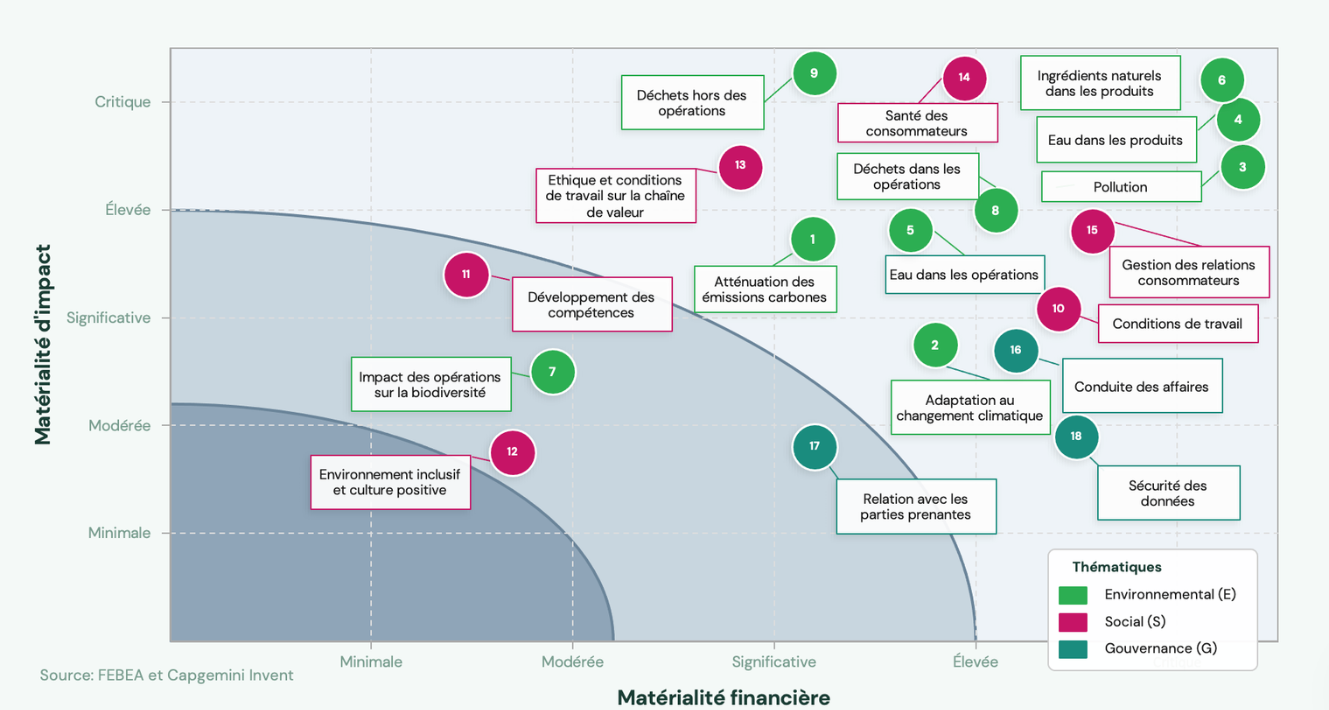
The industry has identified this itself. In the double materiality analysis conducted by FEBEA (Fédération des Entreprises de la Beauté) for the sector, natural resources emerge as a critical issue on both axes at once: high impact materiality, because ingredient sourcing weighs heavily in the product’s footprint; high financial materiality, because the scarcity and price volatility of natural materials pose a direct risk to the business.
This risk is not theoretical. In a guide devoted to sourcing, FEBEA studied eight major plant-based materials in the sector, from palm oil to shea, argan and sunflower, and showed that climate change is displacing or shrinking favourable growing areas: some tropical crops could lose part of their suitable land, while temperate crops could migrate northward.
For the brand, knowing the environmental footprint of its portfolio then amounts to mapping its points of fragility: identifying the ingredients whose disruption or price spike would threaten an entire line, and spotting those for which a less exposed alternative exists. Environmental data becomes an instrument for securing supply as much as a measurement tool. The brand that wants to anticipate this risk will therefore look for contract manufacturers and ingredient suppliers able to document the origin and impact of their materials, and to propose less exposed reformulation paths.
The case of fragrance houses: measuring the impact of a composition the brand does not know
Fragrance is the category where demand for environmental data will fall most fully on the supplier, because it is the product over which the brand has the least visibility. The brand writes an olfactory brief, imposes a formulation charter, sets its exclusions and a level of naturalness, but in most cases it does not know the actual composition of the concentrate.
On the label, the fragrance composition appears under the single word “parfum,” in accordance with the European Cosmetics Regulation (EC) No 1223/2009. Only allergens above a certain threshold must be declared. Regulation (EU) 2023/1545 added 56 new allergens to be declared individually, applicable to new products from 31 July 2026; but this expansion changes nothing essential: it reveals allergens, not a formula. The concentrate remains protected by trade secret.
Measurement will be all the more necessary because fragrance depends on its sourcing more than any other category. It draws on a very large number of ingredients, and that very richness is its fragility: a single one, should it run short or be banned, can threaten the entire composition. And many of these materials are hard to substitute. An ingredient on which a fragrance’s olfactory identity rests does not always have an equivalent: replacing it alters the result, when it does not make it impossible.
These constraints converge on a single consequence: since the brand has access neither to the composition, nor to the supply chains, nor to the concentrate’s points of vulnerability, it cannot produce the environmental data itself. Trade secret does not remove measurement: it designates who must carry it out. Only the fragrance house, which knows the formula and the origin of each material, can produce it, and it is onto the fragrance house that the requirement will fall entirely.
For the contract manufacturer, measuring impact becomes a differentiator
For contract manufacturers, fragrance houses and, more broadly, the suppliers of the cosmetics industry, the ability to measure the environmental impact of what they develop is becoming far more than a regulatory requirement: a differentiator that strengthens the value of their offer.
Brands will increasingly have to demonstrate the environmental performance of their products, under the combined effect of consumer expectations, evolving regulation and their own competitiveness. But they can do so only from data produced upstream in their value chain. The supplier able to document the footprint of its formulas, its raw materials or its processes therefore does not merely provide additional information: it gives its clients a capacity for proof that has become strategic.
This capability also changes the commercial relationship. Switching contract manufacturers remains a heavy decision for a brand; the challenge, then, is not so much to retain a client as to be chosen. In a context where all brands will gradually have to substantiate their environmental performance, suppliers able to produce reliable data will hold a tangible competitive advantage. They will no longer be selected on price, quality or lead times alone, but also on their ability to provide information that has become indispensable.
This advantage will not, however, be permanent. Like any innovation, environmental measurement will first create a gap between those who anticipate it and those who undergo it. Over time, this capability will become a market standard, just as quality or regulatory requirements are today.
Yesterday, suppliers were assessed above all on their ability to develop and manufacture a product. Tomorrow, they will also be assessed on their ability to demonstrate its environmental performance.
Frequently asked questions
Why must a CDMO or fragrance house provide environmental proof? Because the brand does not control what it delegates. The development of the formula, the origin of raw materials and the manufacturing processes, which determine most of a product’s environmental impact, take place at the supplier. Under the combined pressure of consumers and regulation (EMPCO, PPWR, CSRD), brands must prove the environmental performance of their products; they can do so only from data produced upstream, by their contract manufacturers, ingredient suppliers and fragrance houses.
What does the EMPCO Directive require of environmental claims on cosmetics? The EMPCO Directive (Empowering Consumers for the Green Transition, Directive (EU) 2024/825), applicable from September 2026, prohibits generic and unsubstantiated environmental claims. A brand will no longer be able to describe a product as “responsible” or “good for the planet” without documented, verifiable proof. This requires measured impact data, produced throughout the value chain.
Can the environmental impact of a fragrance be measured without knowing its formula? Yes. The composition of a fragrance concentrate is protected by trade secret, but the environmental footprint is calculated material by material, then aggregated at the concentrate level, without the formula being exposed to the client brand. The fragrance house keeps its secret and still provides the impact data.
What method measures the environmental impact of a cosmetic product? Life Cycle Assessment (LCA), standardized under ISO 14040/44, is the reference method. It measures a product’s impact across its entire life cycle, from raw material extraction to end of life. In Europe, the Product Environmental Footprint (PEF) reference provides the common framework, with sixteen impact categories, well beyond carbon alone.
What does the PPWR change for cosmetic packaging? The PPWR (Packaging and Packaging Waste Regulation, Regulation (EU) 2025/40), applicable from August 2026, modulates producers’ financial contributions according to the actual recyclability of their packaging. Documenting the composition and environmental performance of packaging becomes necessary to optimize these eco-contributions and secure access to the European market.
Sources and references
- Regulation (EC) No 1223/2009 on cosmetic products.
- Regulation (EU) 2023/1545 on the labelling of fragrance allergens.
- Directive (EU) 2024/825, “Empowering Consumers for the Green Transition” (EMPCO).
- Regulation (EU) 2025/40 on packaging and packaging waste (PPWR).
- Regulation (EU) 2024/1781 establishing a framework for the ecodesign of sustainable products (ESPR).
- Decree no. 2025-957 of 6 September 2025 on environmental labelling of textile clothing products.
- D. Proserpio et al., “The impact of sustainability programs on consumer purchase behavior,” Amazon / University of Southern California, ScienceDirect, 2025.
- FEBEA (Fédération des Entreprises de la Beauté), double materiality analysis.
- FEBEA (Fédération des Entreprises de la Beauté), guide on plant-based material sourcing.
- European Commission, EU Strategy for Sustainable and Circular Textiles, COM(2022) 141 final, 30 March 2022: https://environment.ec.europa.eu/strategy/textiles-strategy_en
- European Environment Agency (EEA), circularity of the EU textiles value chain: https://www.eea.europa.eu/en/analysis/publications/circularity-of-the-eu-textiles-value-chain-in-numbers


Articles similaires
L'environnement devient un enjeu de compétitivité pour la filière cosmétique
Buisness performance
15 Jul
L'environnement devient un enjeu de compétitivité pour la filière cosmétique
15 Jul
The cost of climate inaction: What Fashion teaches Beauty’s finance leaders
A study shows how climate change is already becoming a factor in profitability.
Buisness performance
8 Jul
The cost of climate inaction: What Fashion teaches Beauty’s finance leaders
A study shows how climate change is already becoming a factor in profitability.
8 Jul